Core Rotating Mechanics
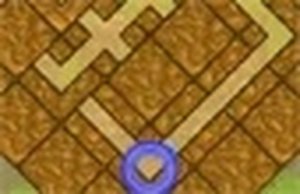
At its heart, Color Path Logic Grid revolves around a simple but deep interaction. Players click on any tile within a square grid to rotate it, changing the direction of paths drawn on its surface. A colored ball rests on one tile, and the goal is to create a continuous route for it to reach a tile of the same color. The twist is that a tile cannot be rotated if a ball is currently on it, forcing players to think ahead about the order of their moves. This single rule creates a satisfying puzzle where each action has consequences.
Board-Wide Strategy
Beyond individual tile rotations, players can rotate the entire square grid using arrows located around its border. This global rotation repositions all balls and pathways simultaneously, opening up new possibilities for connecting routes. Mastering this mechanic is key to solving more complex layouts, as it allows players to shift multiple elements at once rather than adjusting each tile individually. The interplay between local tile rotations and global board rotations gives the game a layered strategic feel.
Level Design and Progression
Each level presents a fresh configuration of tiles, balls, and checkpoints. Early levels introduce the basic mechanics with simple paths, while later stages add more balls, longer routes, and additional checkpoints that must be passed in order. The timer adds a gentle pressure, encouraging efficient thinking without being punishing. Completing a level unlocks the next, gradually building the player's understanding of the system. The difficulty curve feels natural, allowing players to develop their skills at their own pace.
Visual Style and Accessibility
The game uses bright, distinct colors for each ball and its matching target tile, making it easy to identify goals at a glance. The grid is clearly laid out, and tile rotations are accompanied by smooth animations that provide clear feedback. Controls are responsive and work well on both desktop and touch devices. The clean, uncluttered interface means players can focus entirely on the puzzle without distraction. This design makes the game approachable for younger players while still offering depth for adults.
Building Logical Thinking
Color Path Logic Grid is fundamentally about planning and sequencing. Players must consider not only which tile to rotate but also the order of rotations, as moving one ball might block another. The global rotation adds another layer, requiring players to visualize how the entire board will change. This type of spatial reasoning is a valuable mental exercise, and the game presents it in a fun, low-stress format. There are no penalties for taking time, so players can experiment freely to find solutions.